Szász Tibor & Klárik Balázs (HU) - Overcharge / Túlterhelés

Overcharge / Túlterhelés is the first collaboration between Klárik Balázs (blaze), motion designer and VJ, and Szász Tibor, visual creative programmer. The project explores the structural borderlands of generative code systems, real-time image-making and light art, where software architecture directly shapes the visual environment.
Within the creative process, Szász Tibor is responsible for the software background and responsive algorithms. His work is complemented by Klárik Balázs’s more than decade-long experience in live visuals, VJing and animation, defining the projection structure and the visual content of the installation.
Rományi Luca contributed to shaping the processes and chaotic systems behind the work.
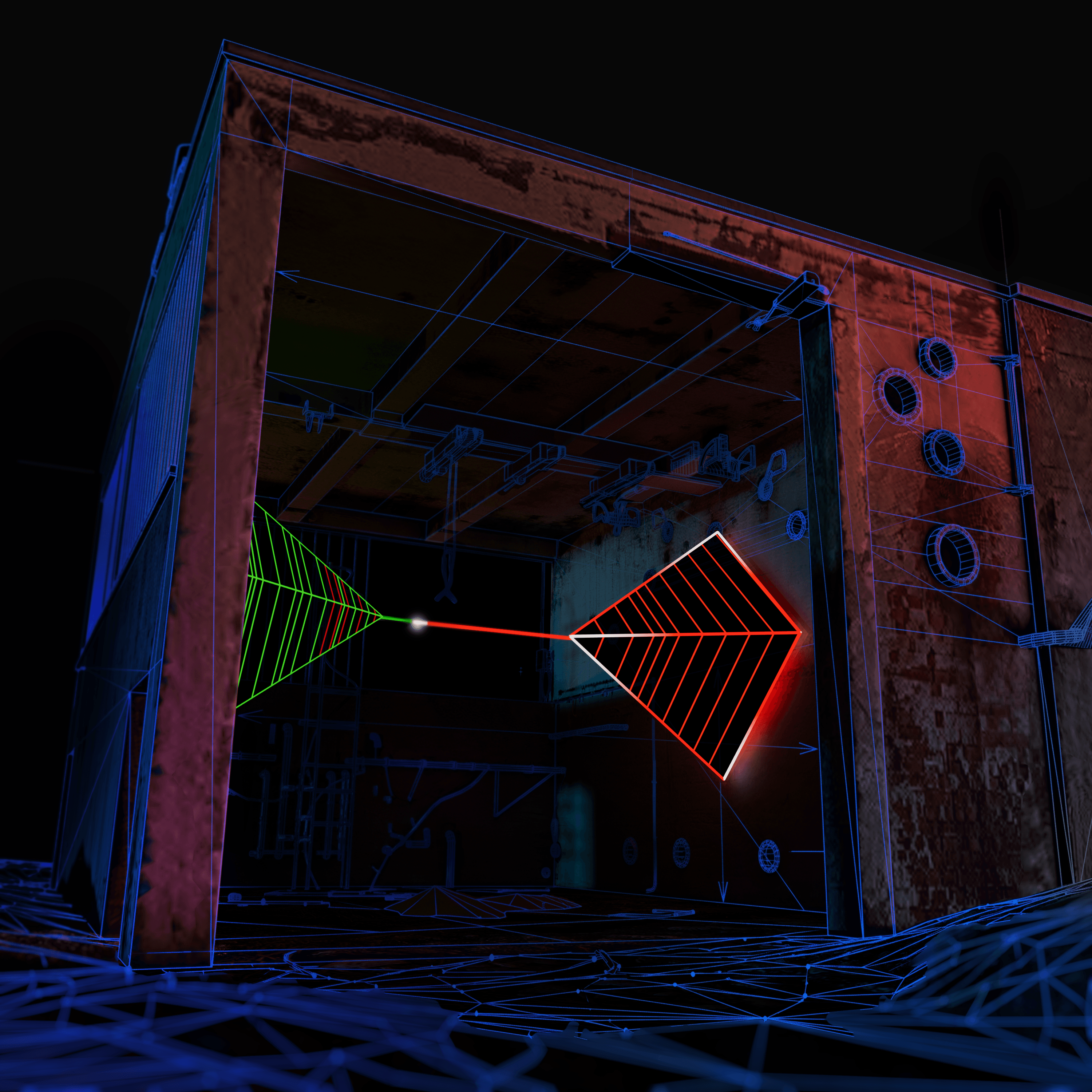
Overcharge / Túlterhelés is an interactive light installation exploring the concepts of charge and energy transfer, responding to the processes that once took place inside the thermal power plant.
The installation appears as spatially arranged, opposing pyramid-like forms. Their relationship is in constant transformation: one may gradually overwrite the functioning of the other, while visitors can also influence this dynamic system.
The viewers’ intervention directly shapes this system of relations. Up to two participants can affect the installation at the same time, continuously modifying the balance of power and the state of charge between the two forms, making the human factor visually perceptible.
The installation is built from projections and LED lights. The emerging lines evoke the play of vibrations: once disturbed from their state of rest, they transform into constantly shifting, wave-like moiré patterns.
The basic equilibrium of the system is disrupted by human intervention. Human presence appears as the factor that disturbs the state of rest, pointing to the impulse through which humans unsettle natural systems in order to use them for their own purposes.
The work is planned for Open Storage, a partially collapsed, open industrial structure. Within this damaged architecture, opposing layered pyramid forms become a shared surface for light, energy transfer and viewer intervention.
Light art